The Heart of Fran’s Kitchen
Introduction to the Book
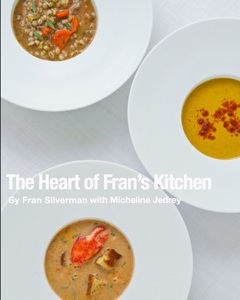
I originally compiled this recipe collection for family and friends. The recipes, like the cooking interests of my family and friends, run from simple to sophisticated, but the recipes include detailed directions and photos as well as audio and video clips to produce success every time at every level of complexity. There are recipes for large parties, for intimate dining and for everything in between. Each recipe is intended to put cooks at ease and make their guests feel contented.
This is a cookbook written by a home cook for home cooks. I am not a chef. I do not cater. I do not own a restaurant. I am not a food critic. I do not have a TV show. I am not a celebrity. I am just like you. When I first started cooking over four decades ago, I relied mostly on four cookbooks – Julia Child’s Mastering the Art of French Cooking, James Beard’s American Cookery, Craig Claiborne’s New York Times Cook Book, and Irma Rombauer’s Joy of Cooking. All were encyclopedic; all were intimidating, but all of them spoke to me. I have not tried every recipe in those books, or every recipe in the dozens of cookbooks I acquired over the years. I only try the ones that interest me. You should do the same with this book.
I learned by trial and error. I made a lot of mistakes. As newly-weds, my husband Rob and I sat down one evening in our tiny apartment to what we still call the “White Dinner” -- skinless chicken breasts, mashed potatoes, and cauliflower covered in a béchamel sauce, all served on a white plate. That was when I started to think about presentation, no matter how simple the recipe. Presentation is the right arrangement of food and drink with the right tableware on the right table in the right setting. Presentation is where chefs succeed and home cooks fail. Follow these recipes consistently, pay attention to presentation, and you will not fail.
“You must have had a lot of time for your cooking,” people say to me. I made the time when I could. When I could not, I stuck with appealing recipes that did not require a lot of time. This cookbook includes recipes that take from fifteen minutes to several hours to prepare. The time required for preparation is stated on the first page of each recipe.
I have not led a leisurely life. I began working as a teenager and worked until my sixties. I became a mom at thirty-one. At that time I was the Registrar and Director of Collection-Sharing at Harvard’s Peabody Museum. It was an interesting place to work – thousands of anthropological objects from all over the world. But something was missing in my life. I talked to my husband about opening a restaurant or starting an interior design firm. I had earned a bachelor’s degree in interior design but never worked at it.
“Which matters most to you,” Rob asked, “food or furniture?”
“Food.”
“Then do interior design,” Rob said. “Keep the food for us.”
I kept the food for us and for our family and friends. I had a successful interior design practice for thirty years, but I always found time to cook, no matter what.
People spend a lot less time cooking at home today than they did when I was young. Actually, they spend very little time doing what I call cooking; they spend time preparing food mostly cooked by others and cleaning up. Many spend a lot of money on home kitchens (I designed many of them for my interior’s clients), and then they eat out much of the time. They watch others cooking on TV, but it does not motivate them to cook for themselves. I understand that this is driven by more women working outside the home (women have always done most of the home cooking), by the ready availability of prepared foods (never mind what’s in them; although you should) and by more people living alone. I don’t expect to change the trend with this cookbook, but for those determined to buck the trend, this book will help. It contains many recipes to make ahead in quantity for later use, a real time saver.
Cooking for me is an on-going accumulation of knowledge and experience. I never stop trying new dishes, but I never abandon the ones best loved by family and friends. For the first five years, I taught myself to cook, but I felt I needed some professional training. I wrote to Julia Child for recommendations. I mentioned that I worked at the Peabody Museum, which was virtually around the corner from her home. She knew the museum housed objects from many remote parts of the world. She asked jokingly if I might share a recipe using “crocodile warts.” Then she responded to my inquiry. “If you have French, I recommend the following places in Switzerland … Otherwise, I recommend the Cordon Bleu School of Cookery in London.” I didn’t “have French.” Harvard granted me a three-month leave of absence to study at the London Cordon Bleu, where I completed what was then called the certificate course. It was enough professional training to continue learning on my own.
I did continue. I have made every one of the more than one hundred recipes in this book many times. I have adjusted each one to suite my own taste and style and in response to comments from family and friends. I urge you to do the same. That is part of the fun. Never hesitate to give and take criticism. The simple dish made right trumps the complicated dish made wrong. The idea is to use familiar ingredients to produce memorable results at any level of complexity. Be ambitious but work your way up gradually from basic to advanced recipes. Cook dishes that make your home smell wonderful.
My close friend of many years Micheline Jedrey had the idea of making this a truly digital cookbook. As the recently retired Vice President for Information Services and College Librarian at Wellesley College, she has an extensive understanding of what is published -- in print and on line. She brought to this project a professional approach to organizing information, an enthusiasm for good food and keen insights into how people behave when they cook. Mich observed that, while there are many cookbooks available as e-books, most are electronic versions of a printed book. There are really few cookbooks born digitally. There are really few e-cookbooks that take full advantage of imbedding audio and video clips as well as traditional still images in text files, resulting in clearer explanations of how to make specific recipes. This cookbook was born digitally and does just that. The recipes are mine. The format is Micheline’s. The book is ours.
Thanks are due to long-time friend and film-maker Chris Knight, whose video clips applied professional methods to amateur talent. Jeff Roberts took the still images that make a dish jump off the page. Emma Farrow brought the mind of a digitally sophisticated Wellesley student to e-book production. Over the last four decades, I have talked to many people about the recipes in this book, but most recently the following friends and family gave me a lot of their time as readers and evaluators: David Silverman, Amy Wu, Chris Jedrey, Nathaniel Jedrey, Hanna Stickland, Francoise Aylmer and Kathy Knight. My husband Rob Silverman has been my faithful recipe critic for nearly half a century. He has tasted every dish in this book, and then some.